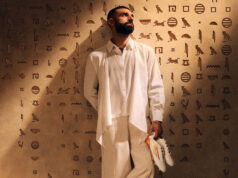

Photographer: KHALED FADDA
Stylist: SARA BAHAA
Suit: Marsom, Shoes: Brava
The world of architecture keeps gracing us with the rise of some amazing Arab and Egyptian talents every once in a while. One of those is none other than Engineer and Architect Muhammad Obaid who is always so keen on bringing joy and peace to his clients through his outstanding vision. We had the opportunity to talk to him about a lot of that – as well as his recent awards, future projects, and so much more!
You’ve won the “Egypt State Award” from the Supreme Council of Culture in 2018 – tell us the story behind your winning project!
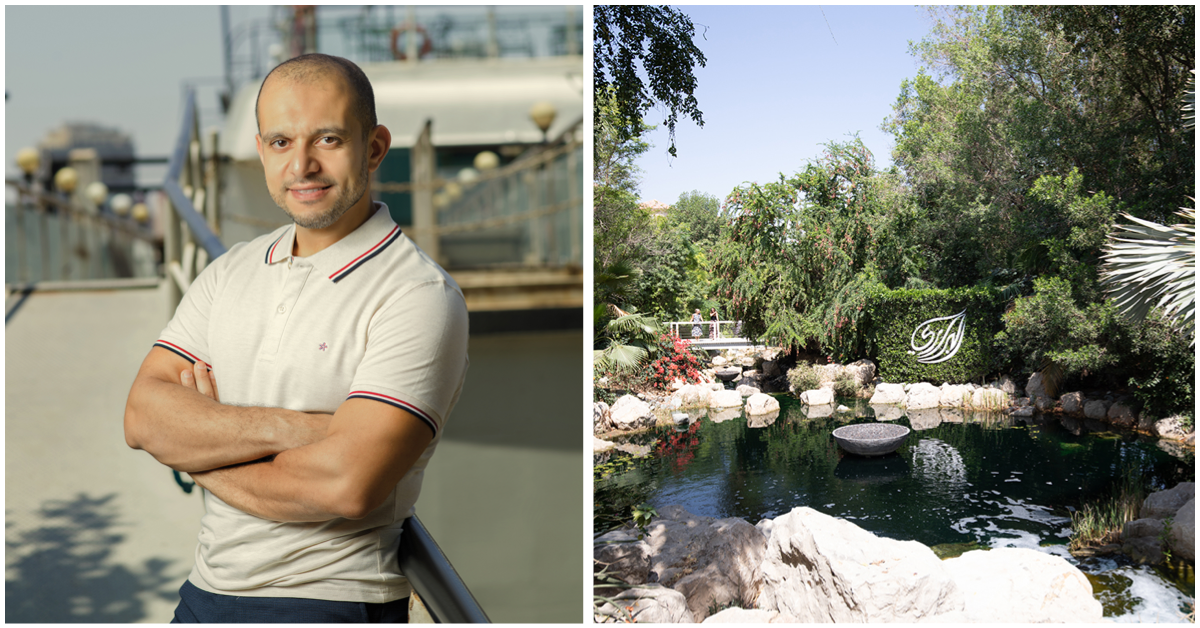
To understand the project more, I have to first describe the natural surroundings of Al Barari community, which is an area covered with heavy plantings and waterways in Dubai’s desert. The flying platforms project was proposed as an
enhancement for an existing structure to increase community involvement and act as a cultural meeting point in a community that has around 200 nationalities, so people can gather and exchange their cultural activities. With the diversity of taste and lifestyle, my design approach was to prioritize the site’s natural environment. The project involved pedestrian paths within the trees, open galleries, and exhibition spaces that could be used for different cultural events
in addition to food and beverage covered zones. Currently, the project is considered one of Dubai’s iconic landmarks which attract visitors even from outside Al Barari’s community.
In 2020, you won the “Cool Abu Dhabi International Competition”; tell us more about the competition and your winning proposal!
The aim of the competition, in a simplified way, is to provide thermal comfort in outdoor urban spaces and try to beat UAE’s hot climate and give people the opportunity to still enjoy the outdoor spaces. One thousand five hundred and seventy participants from 67 countries participated in this competition and the jury only chose 10 winning proposals. My proposal, Circadian Clouds, was one of them.
What does “Circadian Clouds” actually mean and how did you conceive the idea for this design?
The common traditional way of using canopies, pergolas, or any other shading structure to provide outdoor thermal comfort, always blocks the sky and turns the outdoor into a semi-indoor space. The only way to enjoy the outdoors in hot regions is to turn them into indoor spaces unless the sky is cloudy; this is when you really find people enjoying the
outdoor area. The idea was to provide an artificial cloud that is very high and has minimum sky blockage so people will
feel its presence but will not see it unless they look towards the sun. Since the sun is moving, we needed this cloud to also move with the sun to always keep the targeted area in the shade. And that’s how we found the answer, again in nature with the Circadian rhythm. The Circadian rhythm is a biological process that simply responds to the Earth rotation around its axis causing the day and night. A very good example of the Circadian rhythm is how the sunflower uses its Circadian clock to always face the sun. So, we wanted a cloud that follows the Circadian rhythm – that’s why
it’s called the Circadian Clouds.

How do you feel about winning these two important awards?
I feel happy for two reasons; the first is that I first got recognized in my homeland as it really motivated me towards the international win of the second competition. And the second is that I could give my team a living example of how to break the boundaries of the impossible – and it’s achievable. These two awards are milestones in a long journey of
continuous development; they made me feel more confident that my firm and I are on the right path. Ever since my firm (EMKAAN) was founded, we have always allocated time and resources for research and
innovation. It definitely takes time, resources, and a lot of patience but creating architectural and urban spaces that bring joy and happiness to people is totally worth it!
You are an architect who studied engineering, how do you weave science and art together in the realm of building spaces and cities?
The best trait in weavers is patience. Being patient in educating my clients about the importance of taking care of meticulous details in a project and that the building should speak to the five senses, being patient with my team of architects and engineers and educating them to speak about solutions instead of problems, and being patient trying to observe nature and learn from it. When I start a new project, I only try to find a link between the people, the unique qualities of the site and the universe. Only when I find this link do I consider myself successful in the project. Natural science and art are already intertwined – it’s just like two faces of one coin, a flower has a beautiful fragrance, feel and color [art] and it still has very functional small shafts moving liquids from the soil to its petals with leaves around [engineering]. All of that can still be represented through a beautiful mathematical equation in phyllotaxy [science]. I think the answer in brief should be patience and letting myself go with that beautiful flow.
How did being based in Dubai impact you and your firm EMKAAN?
Dubai is a cosmopolitan city; you can easily find yourself surrounded by people from 20 nationalities
in less than 500 square meters. This diversity of multi-cultures brought with it a lot of knowledge and competition, where to keep competing, we need to always be one step ahead and be bold in expressing our ideas.

How do you describe good architecture?
Good architecture is what brings joy and happiness to people, it ignites the positive thoughts and work of minds; it should go beyond what we see to something that speaks to our five senses. It’s a long process of thinking, executing, and weaving art, engineering, and science to ensure that the living spaces are energized with positive energy.
Do you really believe that there is positive or negative energy in the spaces we live in?
I always felt reserved to agree but after seeing my finished designs accommodating different clients from different cultures around the globe, I don’t anymore. This is something that’s very real and in many cultures, they consider it an essential element in designing their environment.
Tell us the story behind EMKAAN!
Ever since I can remember, I had questions whispering in the back of my head; the journey of seeking answers for these questions guided me during my life path. EMKAAN was founded in 2009 in Dubai to help me answer these questions.
Our name, EMKAAN, is derived from the Arabic verb “makkanâ”, which translates to enable. We consider it our mission to enable ideas and to transform them into reality and our name, EMKAAN, always serves as a reminder to us that nothing is impossible. EMKAAN team includes architects, designers, and engineers from different nationalities which allow them all, including myself, to learn from each other and offer this international experience to our clients.

What kind of questions were whispering in the back of your head?
Questions like, can architecture work as an antidepressant? Or, could people be better mannered if surrounded by beautiful architecture? These questions are always driving us to improve in EMKAAN. EMKAAN offers Urban, Architecture, and Interior Design as well as Structural and MEP Engineering – can you talk about your future plans with
EMKAAN and how being so multicultural benefits your clients?

Since we got established in 2009, I’ve dedicated a good amount of time to educate myself and my team on the importance of looking at things from different perspectives, in addition to the day to day project where we offer full in house solutions for different projects; residential, urban or commercial. We’ve always had this small unit that is responsible for conducting researches in different fields of architecture, engineering, and science. Recently, we’ve opened a branch in Abu Dhabi and grew our research team. Consequently, we are trying to be very careful in selecting our clients.
How do you see the architecture and interior fields in Egypt nowadays?
Since 2014 and until today, I sense a strong will to develop Egypt in many areas, including architecture. Architects, designers and engineers hold a huge responsibility to offer their best and I believe they can still do better in terms of attention to detail, considering orientation, offering unique designs, respecting nature, and considering the human aspect to offer better-built environments.
You said that you are very selective in choosing EMKAAN’s client; what type of clients do you work with?
Our clients are those with unique taste and style, who can appreciate the beauty of nature and God’s creation, see value in details and understand that each design should have a unique story.
Going through EMKAAN’s social media, we came across a beautiful video of a project called “The Intriguing”; could you please tell us more about it?
“The Intriguing” is a design methodology where art, engineering, mathematics, science, nature, and psychology are weaved towards the architecture of joy and positiveness of space energy. My personal involvement in projects that follow this methodology is higher than other projects, which makes it kind of a limited edition.
Do you deliver projects or designs in Egypt? Are you planning to open EMKAAN-Egypt soon?
Yes, EMKAAN-EGYPT is located in Waterway building, we’re currently in the process of establishing it. And people can contact me personally on m@emkaan.com